On July 4, 2026, the United States of America will celebrate its 250th birthday. But did you know that, for many Americans, our nation has two birthdays?
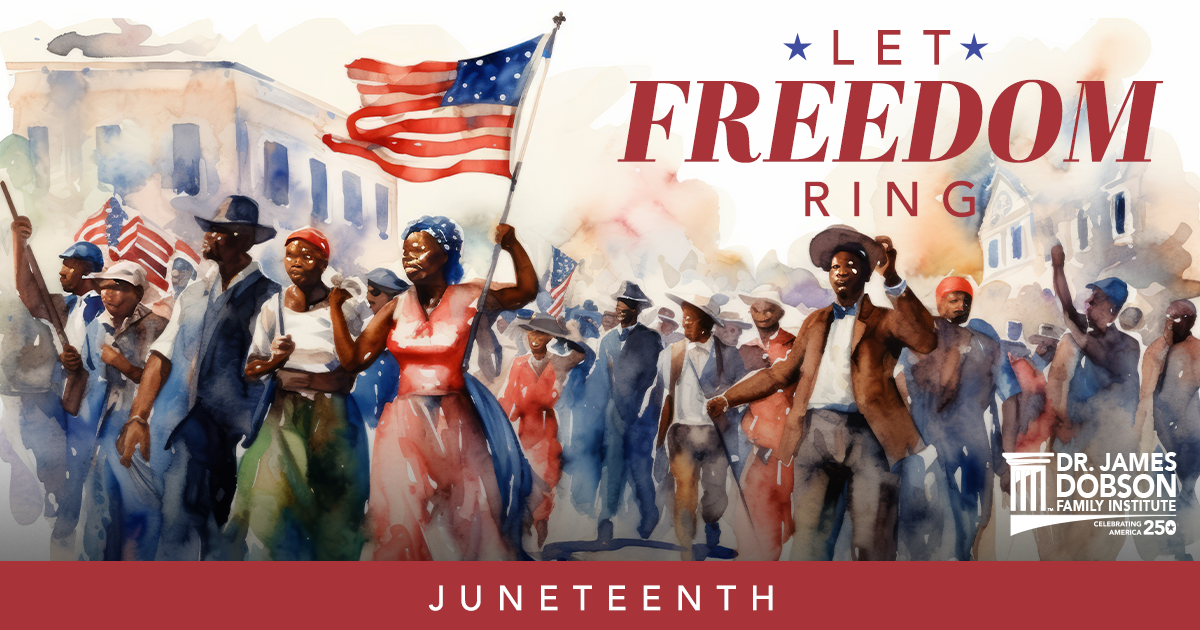
While that day is widely recognized as Independence Day, it was nearly 89 years later—on June 19, 1865—that every American began to celebrate what freedom really means.
When it comes to the foundation of our nation, many of us cherish those powerful words from the second paragraph of the Declaration of Independence:
“We hold these truths to be self-evident . . . that all men are created equal, that they are endowed by their Creator with certain unalienable Rights, that among these are Life, Liberty and the pursuit of Happiness.”
Those biblical principles have been the bedrock of the American Experiment. But eleven years later, when the United States Constitution was signed and later ratified, those promises were not fully extended to a certain group of people living in the new nation—those who had been brought to the New World in the shackles of slavery.
Incredibly, the country that prided itself on declaring that our rights came from God and not from government battled within its own ranks over whether it was legal (and morally permissible) for one man to own another. And, remarkably, both sides used the Word of God, often incorrectly, to defend their arguments. Fortunately, as the nation grew in size and stature, so too did the movement to abolish slavery once and for all.
By 1861, the United States was in the midst of a full-scale Civil War. The fighting claimed hundreds of thousands of lives and nearly claimed our great Republic as one of its casualties as well. But in September 1862, the White House intervened.
With the signing of the Emancipation Proclamation on January 1, 1863, President Abraham Lincoln took a bold step in preserving our union by freeing those held in slavery in the seceded Confederate States. While some exemptions were allowed, the tide to end slavery in the United States had begun to turn.
One by one, as the Union armies overtook their Confederate foes, those held in slavery in those states were freed. Then, on April 9, 1865, General Robert E. Lee famously surrendered his Army of Northern Virginia to Union General Ulysses S. Grant at the Appomattox Court House in Virginia. The Civil War was officially over—but the final Confederate opposition had yet to concede.
On June 19, 1865, Major General Gordon Grainger arrived on the Isle of Galveston to inform the people of Texas that by virtue of President Lincoln’s executive order, all enslaved people in Texas were now free.
The following year, on the same day, several formerly enslaved people in the Galveston area joined together to commemorate what was known as “Jubilee Day.” Over the years, these celebrations grew in popularity, spreading throughout former Confederate States as well as into some Union territory. The term “Juneteenth” first appeared in newspaper reports of the celebrations dating back to 1891.
Of course, the Emancipation Proclamation didn’t end slavery. The 13th Amendment did, though it wasn’t ratified until December 1865. The Reconstruction Era began shortly thereafter with the hopes of rebuilding and restoring our nation. Unfortunately, America continued to experience racial tensions over the next 100 years due to segregation and Jim Crow laws, which remain a shameful stain on our storied legacy.
The Civil Rights Movement ushered in a new era of greater awareness and understanding of the atrocities that slavery brought to our country. But the events of June 19, 1865, in Galveston, Texas, marked a turning point that moved the United States closer to fulfilling the vision for which the Founders pledged their “lives, fortunes, and sacred honor.”
As America prepares to celebrate the 250th anniversary of its Declaration of Independence from Great Britain this July 4, may we begin that celebration a few days early: on June 19.
Juneteenth is a celebration for all Americans—a powerful reminder that God will continue to extend His hand of Providence to those who seek His face and continue to turn from our wicked ways. Life, Liberty and the pursuit of Happiness begin when we acknowledge our dependence on God, and remember that we are all image-bearers of our true King!