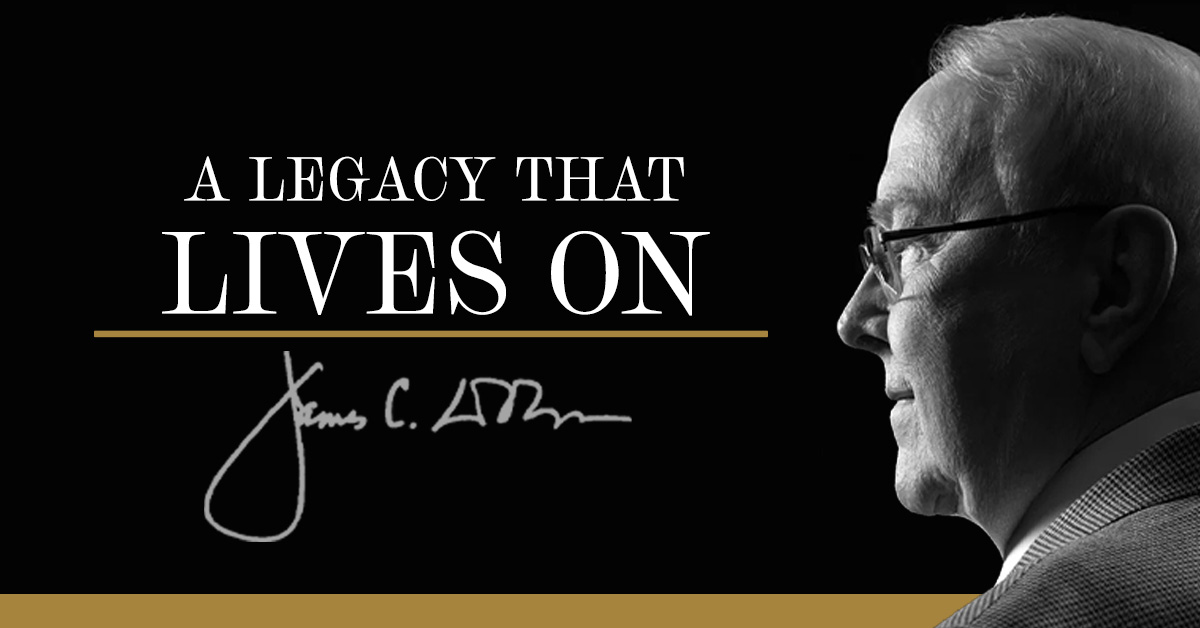
Some voices don’t just fill the airwaves—they reach into broken places and reveal what others are afraid to say. For generations of families, Dr. James Dobson was one of those voices.
Vice President JD Vance recently reflected on the impact Dr. Dobson had on his own life: “He was a good Christian guy. He talked about the family. He talked about things I cared a lot about, and I came from a broken home.” When Dobson spoke about the ways a fractured family can impact a child’s future, Vance said, “it made sense to me because I was seeing it in my own life. Here was a guy who was actually talking about it.”
That was the power of Dr. Dobson. He didn’t speak in abstractions. He spoke to families at kitchen tables and while riding in the car; to single mothers and overwhelmed fathers, to children growing up in homes that felt unsteady. He drew attention to what many were living—and provided hope that it didn’t have to be the end of the story.
For decades, parents pulled their kitchen chairs a little closer to the radio. They dogeared Dr. Dobson’s books, underlined paragraphs, and whispered, “I needed that.” In living rooms and minivans and late-night moments of desperation, Dr. Dobson did something extraordinary: he instructed and equipped parents. And by doing so, he helped raise their children.
As we reflect on what would have been his 90th year, we remember not only the milestones of a remarkable life, but the steady influence he had around the world.
Ryan Dobson wrote after his father’s passing, “For God did not send his Son into the world to condemn the world, but to save the world through him.” —John 3:17. “That was my dad’s heart,” Ryan said. “Yes, he was bold. Yes, he spoke hard truths. But beneath all of it was a deep, quiet desire to help families, to protect children, and to introduce people to Jesus. Not to condemn. To save. To restore. To heal.”
One of the most beautiful reflections of that heart was the birth of the Snowflake baby adoption movement. Frozen embryos—tiny lives suspended in time—were given the chance to be adopted and brought to full term. Dr. Dobson didn’t just endorse the idea, he embraced it. He promoted it on his radio broadcast. The first “Snowflake baby,” a little girl named Hannah Strege, became deeply personal to him. He became her godfather.
Think about that.
He wasn’t content to speak about life in theory. He celebrated it in practice. Hannah was the first, but she was not the last. Since then, thousands of frozen embryos have been adopted through the Snowflakes program—children who might never have been born. Each one is a quiet testimony that conviction, when paired with compassion, changes history.
And Hannah wasn’t the only one who called him “godfather.” Over the years, dozens of children were spiritually claimed by him—not through formality, but through a heart that genuinely cared. He showed up. He prayed. He remembered names. He asked about school. He listened.
Dr. Dobson understood something many never comprehend: influence is not measured in applause. It’s measured through generations.
There are stories everywhere. Parents who were at the end of themselves, ready to give up. Fathers who had no roadmap because they grew up without role models. Mothers drowning in guilt and comparison. They found not condemnation—but clarity. Not shame—but strength. And because they were stabilized, their children flourished.
That is legacy.
In 1997, while standing before graduates at Huntington University, Dr. Dobson told a story about a tennis trophy with his name on it that he once believed would be displayed permanently at his alma mater—only to discover years later that it had been discarded in a garbage bin. “Given enough time,” he said, “life will trash your trophies.”
Then he talked about something far more worthy to aspire to.
He urged them to apply an “end-of-life test” to everything. Because when the noise fades, and the applause dies, only three things matter: “Those whom you love, who loves you, and what you did together in the service of the Lord.”
And then he said these words about eternity that feel even heavier now:
“On resurrection morning, be there. I will be looking for you then. Nothing else matters. Be there.”
That was the heartbeat beneath everything Dr. Dobson lived and taught. It wasn’t about aiming for success or fame. It was about presence—spending quality time with your children and grandchildren, taking a stand for the unborn, caring for the hurting, and living each day with eternity in view. His message always pointed beyond himself to the only One who truly saves—Jesus Christ.
On what would have been his 90th birthday, we don’t just remember a broadcaster or an author. We remember a man who helped parents love better, live braver, and aim higher—a man who impacted generations.
And, as his daughter Danae so eloquently affirmed at his memorial service, if he were here to say one final statement, it would simply be this:
Be there.