All of us at the Dr. James Dobson Family Institute (JDFI) are looking forward to celebrating Thanksgiving, as you are. I love this uniquely American holiday. But it’s not just a day off work or a day devoted to parades and football (not even to turkeys and pumpkin pies!). As the name implies, Thanksgiving is about giving thanks to God for the blessings we enjoy.
In addition to everything else, Thanksgiving is an excellent time for us to help our children and grandchildren understand the wonder of America and how central God has been throughout our history to the survival of this great Republic. One way to do this is to reflect on what presidents of both parties have said to the American people as we approached the holiday.
Thanksgiving traces its origins to the Pilgrims—those hardy pioneers who arrived on the shores of North America and, against all odds, carved a nation out of the wilderness. They came to the New World not seeking fortune, but in search of freedom—more specifically, the freedom to worship God as they wished.
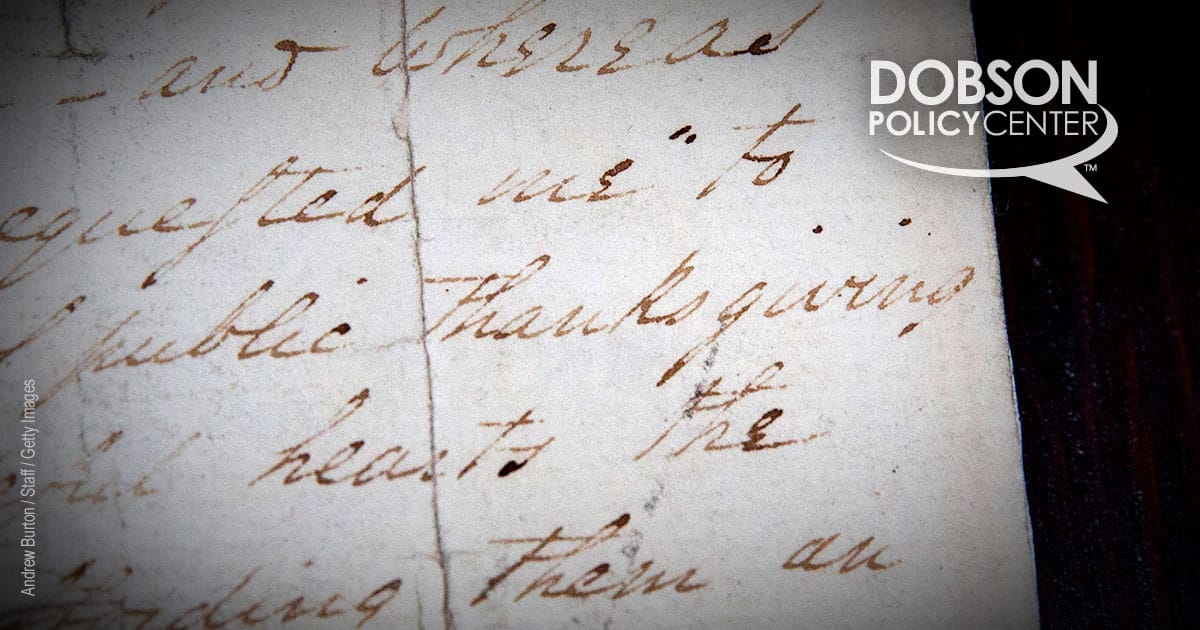
Testifying to America’s rich religious heritage, thanking God for His blessings was a routine experience in our early years. The first official National Proclamation of Thanksgiving was issued by the Continental Congress on November 1, 1777,1 in celebration of our victory over the British at the Battle of Saratoga.
Our first president, George Washington, established the tradition of holding a day of Thanksgiving at the end of November. In his Thanksgiving proclamation of 1789, Washington wrote:
Whereas it is the duty of all Nations to acknowledge the providence of Almighty God, to obey His will, to be grateful for His benefits, and humbly to implore His protection and favor . . . Now therefore I do recommend and assign Thursday the 26th day of November next to be devoted by the People of these States to the service of that great and glorious Being, who is the beneficent Author of all the good that was, that is, or that will be.
That we may then all unite in rendering unto Him our sincere and humble thanks—for His kind care and protection of the People of this Country previous to their becoming a Nation . . . and the favorable interpositions of His Providence which we experienced in the course and conclusion of the late war.
For the great degree of tranquility, union, and plenty, which we have since enjoyed—for the peaceable and rational manner, in which we have been enabled to establish constitutions of government for our safety and happiness . . . for the civil and religious liberty with which we are blessed . . . and in general for all the great and various favors which He hath been pleased to confer upon us.2
Read his words again. Two things stand out. First, Washington was very much aware of and grateful for God’s blessings on America in the Revolutionary War. Second, he understood the uniqueness of what he and the other giants of our founding had accomplished: tranquility, union, and civil and religious liberty. This was not how most revolutions ended in Washington’s day.
Even amid the horrors of our Civil War, President Abraham Lincoln still saw God’s blessing. In his 1863 Thanksgiving proclamation, Lincoln declared:
The year that is drawing toward its close has been filled with the blessings of fruitful fields and healthful skies. To these bounties, which are so constantly enjoyed that we are prone to forget the source from which they come, others have been added, which are of so extraordinary a nature that they cannot fail to penetrate and even soften the heart which is habitually insensible to the ever-watchful providence of Almighty God . . .
No human counsel hath devised, nor hath any mortal hand worked out these great things. They are the gracious gifts of the Most High God, who while dealing with us in anger for our sins, hath nevertheless remembered mercy.
It has seemed to me fit and proper that they should be solemnly, reverently, and gratefully acknowledged as with one heart and one voice by the whole American people. I do, therefore, invite my fellow citizens in every part of the United States, and also those who are at sea and those who are sojourning in foreign lands, to set apart and observe the last Thursday of November next as a Day of Thanksgiving and Praise to our beneficent Father who dwelleth in the heavens.3
As America confronted a world at war in 1941, Congress voted to establish Thanksgiving as a national holiday. President Franklin D. Roosevelt declared:
. . . We are grateful to the Father of us all for the innumerable daily manifestations of His beneficent mercy in affairs both public and private, for the bounties of the harvest, for opportunities to labor and to serve, and for the continuance of those homely joys and satisfactions which enrich our lives.
Let us ask the Divine Blessing on our decision and determination to protect our way of life against the forces of evil and slavery, which seek in these days to encompass us.
On the day appointed for this purpose, let us reflect at our homes or places of worship on the goodness of God, and, in giving thanks, let us pray for a speedy end to strife and the establishment on earth of freedom, brotherhood, and justice for enduring time.4
In his first Thanksgiving proclamation, President Ronald Reagan wrote:
America has much for which to be thankful . . . In keeping with America’s heritage, one day each year is set aside for giving thanks to God for all of His blessings . . . Searching our hearts, we should ask what we can do as individuals to demonstrate our gratitude to God for all He has done . . .
Let us recommit ourselves to that devotion to God and family that has played such an important role in making this a great Nation, and which will be needed as a source of strength if we are to remain a great people.5
What are you thankful for? A job? A warm home? A loving family? Good health? All of these, or something completely different?
In spite of all the challenges we face, we can be thankful to be Americans. We are the descendants of the patriots who declared these words: “All men are created equal and endowed by their Creator with certain unalienable rights, that among these are life, liberty, and the pursuit of happiness.”6
I am thankful for the hard-won privilege we have to elect our leaders, for our religious liberty, and for our freedom of expression. We must never take these freedoms for granted. JDFI is fighting hard to defend them every day! We are thankful for the prayers and generosity of so many good friends who support and sustain our work.
I am thankful we have a chance to restore our Republic. The prayers of Roosevelt, calling for the protection of our way of life against the forces of evil and slavery, and Reagan, urging us to rededicate ourselves to the values of faith and family, remain just as relevant today—if not more so—as they were in 1941 and 1981.
This Thanksgiving, please join JDFI in thanking God for His blessings and mercies. And, for the sake of our children and grandchildren, pray that He would give us the strength and wisdom to persevere in the battle to save this great experiment in ordered liberty under God with which George Washington and our Founding Fathers blessed us.
- In Congress. November 1, 1777. Forasmuch as it is the indispensible duty of all men to adore the superintending providence of Almighty God… [Congressional proclamation], Nov. 1, 1777, PDF, Library of Congress, https://tile.loc.gov/storage-services/service/rbc/rbpe/rbpe04/rbpe040/04001400/04001400.pdf
- George Washington, Thanksgiving Proclamation, 3 October 1789, Founders Online, National Archives, https://founders.archives.gov/documents/Washington/05-04-02-0091
- Abraham Lincoln, Proclamation of Thanksgiving, 3 October 1863, Washington, D.C., online at Abraham Lincoln Online, https://www.abrahamlincolnonline.org/lincoln/speeches/thanks.htm
- Franklin D. Roosevelt, Proclamation 2522 — Thanksgiving Day, 1941. Washington, D.C.: The White House, November 8, 1941. American Presidency Project. https://www.presidency.ucsb.edu/documents/proclamation-2522-thanksgiving-day-1941
- Ronald Reagan, Proclamation 4883 — Thanksgiving Day, 1981, November 12, 1981, Ronald Reagan Presidential Library, https://www.reaganlibrary.gov/archives/speech/proclamation-4883-thanksgiving-day-1981
- United States, Declaration of Independence, July 4, 1776, National Archives, https://www.archives.gov/founding-docs/declaration-transcript