America just observed Memorial Day 2026. Every Memorial Day is poignant, meaningful, a time of remembrance, and, hopefully, gratitude. This year’s observance seemed even more so as America celebrates its 250th birthday. But even before we were a nation, our heroes fought and died for our freedom.
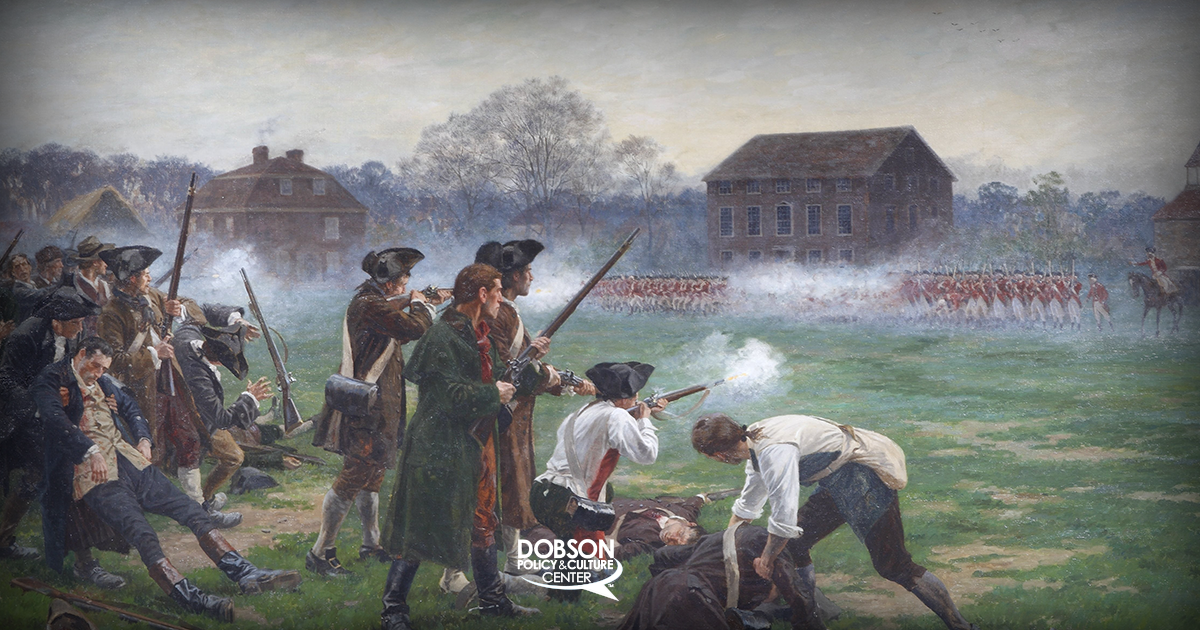
On the morning of April 19, 1775, members of the American colonial militia, made up of farmers and shop owners, rushed to Concord Bridge in Massachusetts to confront British troops searching for banned munitions. Shots were fired at the bridge and two colonists were killed. The battle then spread for sixteen miles from Concord to Boston, involving 1,700 British regular troops and 4,000 colonial militia. The American War for Independence had begun.
Many years later, one of the last survivors who fought at Concord was asked by a historian why he, a mere farmer untrained in warfare, said goodbye to his family, grabbed a musket, and rushed out to confront the army of the world’s greatest military power. Had he been inspired by political philosophers like John Locke? The old man said he had never heard of him.
Was it the onerous tea tax, then, that drove him to risk everything? The old man said he never drank the stuff.
The exasperated historian nearly shouted, “What was the matter?”
The farmer calmly replied, “We always had governed ourselves, and we always meant to. They didn’t mean we should.”1
Our nation has always been built on a devotion to freedom. Not untethered freedom that leads to decay and destruction, but to ordered liberty under God—liberty built on virtue.
Ronald Reagan delivered his farewell address to the nation on January 11, 1989. It is a masterpiece, an ode of love for faith, family, and freedom. He relates a story that happened after the fall of Saigon. For years, a great mass of humanity was trying desperately to escape Southeast Asia to prevent being enslaved by godless communism.
Reagan described a sailor hard at work on the carrier USS Midway on patrol in the South China Sea. Reagan said, “The sailor, like most American servicemen, was young, smart, and fiercely observant. The crew spied on the horizon a leaky little boat. And crammed inside were refugees from Indochina hoping to get to America. The Midway sent a small launch to bring them to the ship and safety. As the refugees made their way through the choppy seas, one spied the sailor on deck and stood up and called out to him. He yelled, ‘Hello, American sailor. Hello, freedom men.’”2
Reagan told the American people the meeting on the South China Sea was “a small moment with a big meaning.”3
America’s military has always been freedom’s defenders. They have not fought to conquer others; they fought and died to liberate others.
Memorial Day weekend here in Washington, DC, was not blessed with much sunlight, but the enduring spirit of America continued to shine brightly. Tourists trekked through waves of torrential rain to visit the memorials that dot the city.
The Vietnam Veterans Memorial is the most visited memorial on the National Mall in Washington, DC. More than five million people go to the massive wall each year, where the names of more than 58,000 servicemen and women who gave their all during the Vietnam War are inscribed.
This year, on the morning of Thursday, May 21, for the eighth consecutive year, a group of military veterans in Congress from both parties quietly gathered at the memorial to wash the wall in an act of remembrance and devotion.
“‘The wall is sacred ground,’ said Representatives Jake Ellzey (R-TX) and Don Davis (D-NC), co-chairs of the For Country Caucus. ‘The names on it belong to Americans who answered the call without asking who stood with them politically. Coming together as veterans to honor them is how we keep faith with that same standard.’”4
The American people have quietly paid their own honor and devotion at the wall since it was dedicated on November 13, 1982. Every day, visitors leave mementos at the base of the memorial: perhaps a single rose, a family photo, a tear-stained handkerchief, or a family Bible. The Park Police carefully gather these symbols of love and devotion at the end of the day, catalogue them, and store them away. The next day, the “offerings” begin anew.
These are the things of faith, family, and freedom. They have more power than all the “movers and shakers” of Washington, DC.
These are the values Dr. Dobson devoted his life to and that all of us at the James Dobson Family Institute fight for today.
- Texas Public Policy Foundation, “239th Year of American Independence,” July 4, 2015, Texas Policy Foundation.
- Ronald Reagan, “Farewell Address to the Nation,” January 11, 1989, Ronald Reagan Presidential Library and Museum.
- Reagan, “Farewell Address to the Nation.”
- Abigail Trotter, “The Last Three Vietnam Veterans in Congress Return to the Wall Together Ahead of Memorial Day,” With Honor Action, May 21, 2026, With Honor Action